

Taking water to the Jordan

A Bedouin woman in the Jordan Valley. Bedouins in the area face harsh restrictions on their use of water (Photo: Doris R., EAPPI).
Yesterday evening I was handing out bottles of water within a few miles of Israel/Palestine’s only major river. The village of Al Fasayel lies in a desert landscape, a contrast to nearby Israeli agricultural settlements, which have access to almost unlimited water. Al Fasayel itself has not had clean water on tap for over seven weeks.
The Jordan Valley is an area of stunning natural and rugged beauty. The mountainsides are barren, the illegal settlements in the valley floor dark, fertile green. But this is also an area of discrimination and grinding poverty.
The first time we visited Al Fasayel we were offered glasses of sweet tea. It was only when we went outside to talk with the children that they showed us a tap that has been dry for almost two months.
Tony Blair, envoy of the Quartet on the Middle East, recently visited the village and managed to persuade the Israeli authorities to rescind a demolition order on the local school. But the village remains without water. The Palestinian and Israeli water companies blame each other for the problem and have referred the problem to a third party.
This is not a unique problem for these remote communities. Ever since 1967 when it occupied the area, Israel has denied Palestinians access to the waters of the Jordan River. Instead they rely on the shared Mountain Aquifer – to which Israeli settlements have privileged access. Israel makes it near impossible for Palestinians in some areas to repair decrepit water infrastructure. According to a recent report by Amnesty International, Israeli army often smashes up rainwater harvesting cisterns.
Near Al Fasayel lies the Bedouin encampment of Ein Al Hilweh. The 25 families living in these modest tents have to collect their water from a well an hour’s drive away. The army sometimes bans them from using the road, and trip to collect water may bring a fine of several hundred shekels. The settlers, who live in well-built houses with running water, also regularly harass the Bedouin.
What could we do? Two weeks ago two we met a local businessman, Arab Al-Shorafa, who runs the Yanabee, a company that sells bottled water. He was also the Mayor of the Palestinian town of Beita. We had contacted him using the phone number on the back of one of the company’s water bottles, and told him about the situation in Al Fasayel.
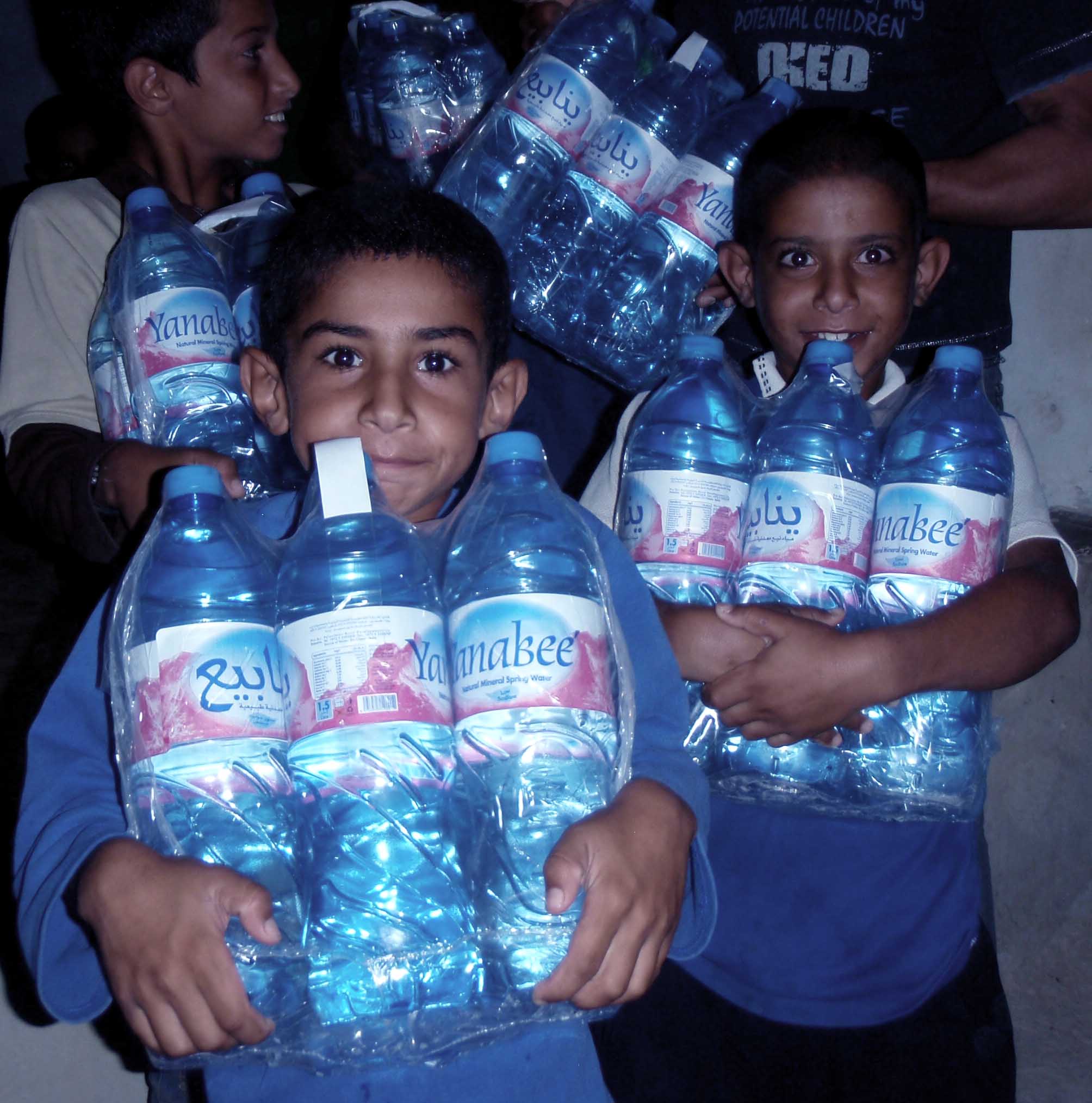
Immediately he offered to supply 80 packs of 6 x 1 ½ litre bottles of water if we could collect them from the factory that evening. He phoned back later offering to increase the number to 3000 bottles.
We agreed to collect and deliver the first batch that night. We drove to the factory and loaded the van. Mr Al-Shorofa met us and promised to provide more water and the truck for another delivery the next day.
We drove back to Fassayel. By then it was dark, we distributed the water to the families as they appeared through the darkness with their children. The next morning, with temperatures in the mid-30s centigrade, we delivered another batch.
Our deliveries have provided enough water for each family in that village for a week. But Mr Al-Shorofa’s act of charity merely underscores the fact that ensuring access to adequate food and water is the duty of the occupying power.
Many locals believe that Israel’s failure to fulfill this is part of a strategy to drive them from their ancestral lands. As we delivered bottles of water in the searing heat, we could understand their point of view.
Sign up for updates from EAPPI at http://bit.ly/eappi-facebook


